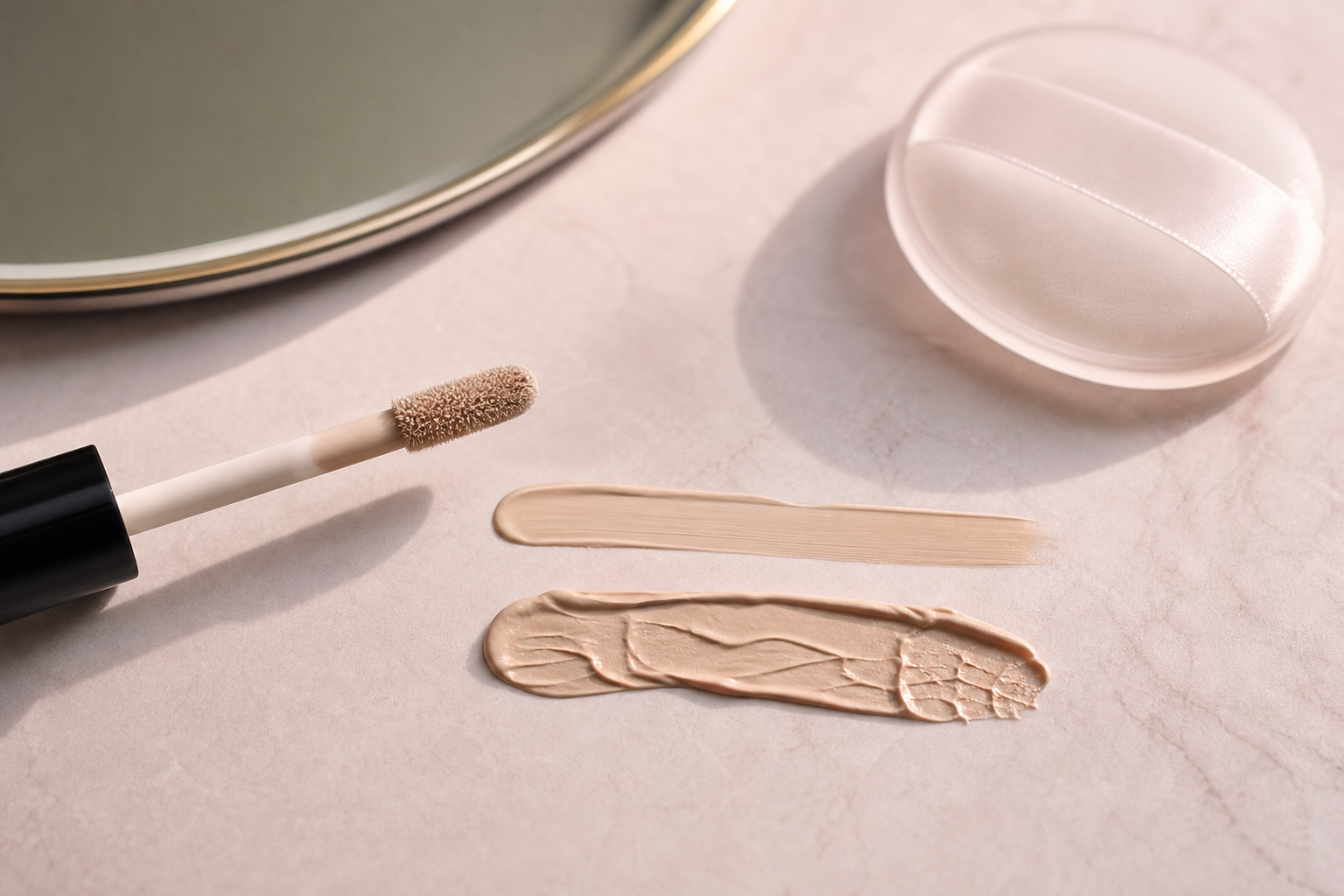
You apply concealer, blink, and suddenly there’s a map of lines where you wanted a smooth, brightened finish. That crease isn’t a beauty failing — it’s physics. Product sits on a moving, textured surface; when the two don’t play nicely, the formula folds into the nearest line. The good news: most creasing can be minimized with smarter prep, less product and cleaner technique. Below is what’s actually happening and how to fix it now — plus a suggested reproducible test method editorial teams can use if they want comparative data.
Why concealer creases
Concealer creases when three things collide: the skin, the product, and movement.
Too much product: bulk is the enemy. Thick layers don’t meld with skin — they sit on top and fold as the skin moves.
Skin movement: the under-eye is one of the most active facial areas. Blinking, smiling and talking repeatedly crease the surface.
Oil and moisture imbalance: a slick surface makes product slide and bunch; very dry, textured skin makes product sit in lines.
Layer incompatibility: creams, silicones, powders and setting products don’t always mix. Incompatible layers can pill, separate or appear patchy.
Practical, no-nonsense fixes
Hydration matters, but timing does too. Use a lightweight, fast-absorbing eye cream if the area feels dry; give it a moment to sink in so the skin reads slightly tacky rather than slippery. For mature or textured under-eyes choose moisturisers that add slip without weight. Heavy oils or greasy balms can make products slip — avoid them directly under the concealer.
Less is better. Dot a very small amount of concealer on the inner half of the under-eye (that’s usually where darkness is worst), then tap, don’t swipe. Warm the product between fingertip and skin, and use gentle tapping motions to press product into skin; avoid stretching or dragging the area. If you still need coverage, layer a second thin coat rather than starting with a mask of product.
A natural or slightly luminous finish typically reads smoother in motion than a dead-flat matte, which can emphasize texture. When you set, do it only where necessary. Pick a finely milled translucent powder, load a small brush or puff and press the powder into the skin — avoid sweeping motions that displace product. For oilier skin consider a light absorbent powder elsewhere on the face, but keep the under-eye powder minimal.
If creasing appears mid-day, resist the urge to pile on more concealer. Gently press the area with your ring finger to redistribute product. If the product has separated, a tiny dab of moisturiser can resettle it — blot first to remove excess oil, then pat the dab into place. Rubbing makes everything worse.
Color correctors help but can add volume. If you need correction and coverage, use a thin corrector, then a thin concealer, rather than multiple heavy products. The same rule applies to primers and under-eye treatments: fewer, compatible layers beat a long stack.
Suggested reproducible editorial test
If an editorial team wants evidence rather than anecdote, use a consistent, repeatable protocol to compare concealers’ recoverability. Label any timings or specific steps below as suggested parameters, not absolutes — results will vary with skin type and conditions.
Standardise prep: start from a clean face, apply a consistent amount of a chosen moisturiser, and allow a defined absorption window. This is a recommended parameter for testing only.
Apply measured product: apply a consistent, small measured amount of concealer in a defined shape under the eye, using the same application technique for each sample.
Simulate movement: perform a pre-defined series of blink and smile cycles to mimic everyday facial motion.
Photograph consistently: capture images at 0, 2, 4 and 8 hours in fixed, controlled lighting to compare wear.
Recovery phase: follow a standardised recovery technique — gentle press, a tiny dab of moisturiser, or a minimal targeted re-tap of product — and photograph immediate and 10-minute results.
Score objectively: evaluate crease depth, product separation and visible texture pre- and post-recovery using a consistent scoring rubric.
This method separates real-world recoverability from marketing claims. If used, ensure the same lighting, camera settings, application quantities and scoring criteria are applied across all samples so comparisons are fair.
Bottom line
Creasing is fixable in most cases. The solution is rarely more product — it’s better product pairing, less bulk, smarter technique and measured setting. If a concealer still creases after those steps, it’s likely a formula mismatch — not you — and a standardised editorial comparison can help determine which formulas genuinely recover.